Helium does not raise the pitch of your voice. The pitch is set by your vocal folds, and they vibrate at the same rate whether your throat is full of air or of helium. What helium changes is the timbre, the tone colour. Sound travels nearly three times faster in helium than in air, so the natural resonances of your throat and mouth move up, the higher parts of your voice get louder, and the result sounds thin, reedy and duck-like. Our ears read that as a higher voice. Sing a note in helium and it is still the same note.
Two parts of a voice
Speech scientists split a voice into two parts, a source and a filter. The source is in the larynx: the vocal folds open and close many times a second and chop the air from your lungs into a buzz. The rate of that buzz is the pitch you hear. It depends on the tension, mass and shape of the folds, which your muscles control.
The buzz is not a single tone. It is a stack of harmonics, the main note plus fainter copies at two, three, four times its frequency and so on. On a chart they look like a row of evenly spaced lines.
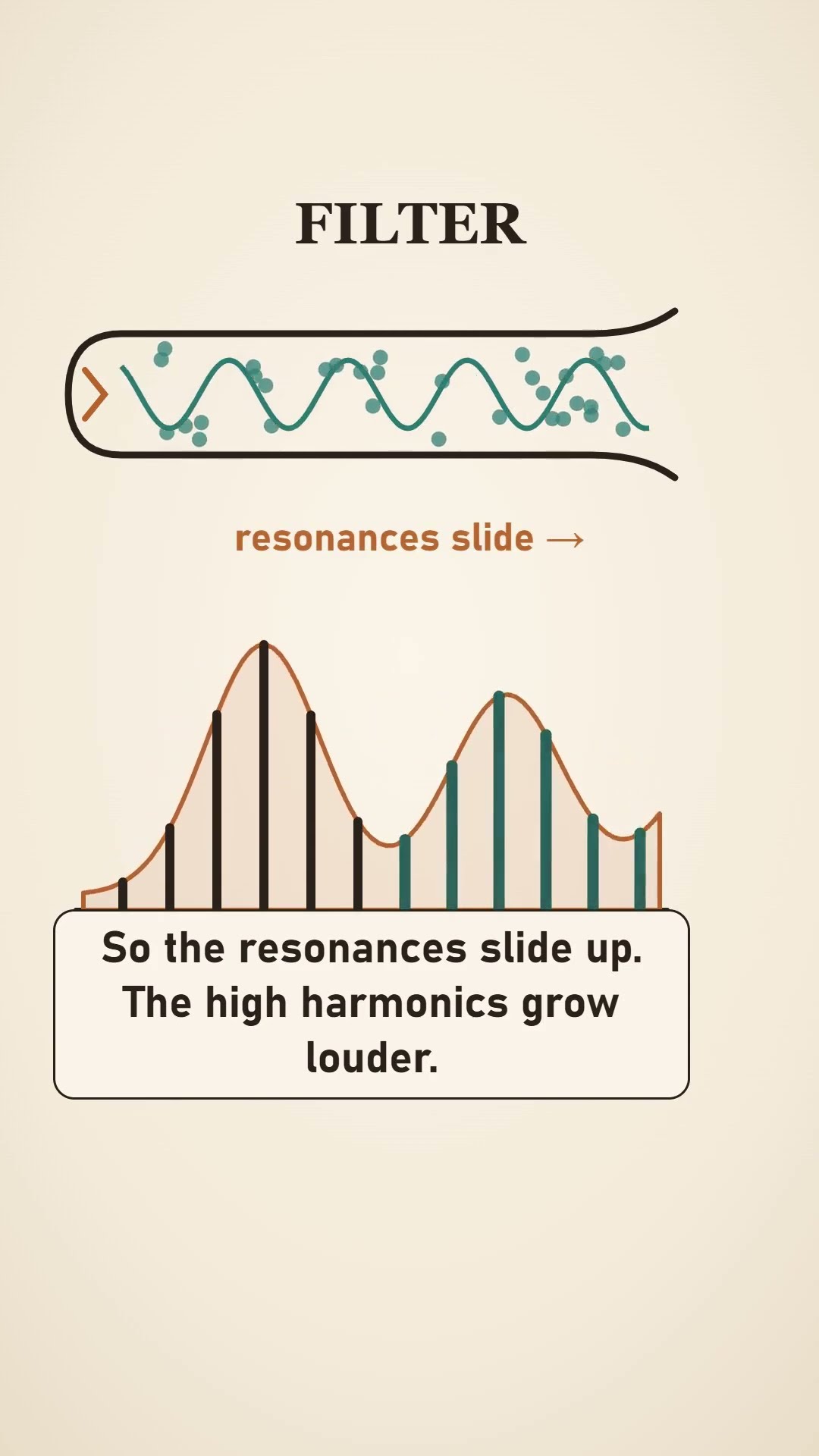
The filter is the vocal tract, the tube of throat and mouth above the larynx. Like any air-filled cavity, it has resonances, frequencies it amplifies. They appear as humps over the row of harmonics, and phoneticians call them formants. Moving your tongue and lips moves the humps, and that is how you make different vowels.
What helium moves
The resonance of a cavity depends on the speed of sound in the gas inside it. Sound travels nearly three times faster in helium than in air, so when your vocal tract is filled with helium its resonances move up.
The harmonics stay where they were, because the vocal folds have not changed. But the humps that shape them have slid towards higher frequencies, so the higher harmonics are boosted. That is why the voice sounds so strange: the note is the same, but the balance of the sound has changed. In ordinary speech we do not listen closely to pitch, so the brighter, reedier sound is easily mistaken for a higher voice. Sing instead of speaking and the illusion falls apart.
A dense gas does the opposite. Sulfur hexafluoride lowers the resonances of the vocal tract and makes a voice sound deep and boomy, again without changing the note.
Why not to try it
The party trick has a cost. Helium is not poisonous, but it is a simple asphyxiant: every breath of it is a breath without the oxygen your body needs, and people have died from inhaling it. The Short shows the physics so that nobody has to test it.
Element 2
Helium is element 2, a noble gas that hardly reacts with anything. It is rare on Earth but common in the universe: the second most abundant element after hydrogen, about 24 percent of all ordinary matter by mass. The element of the Sun, it turns out, changes the tone of a voice, never the note.