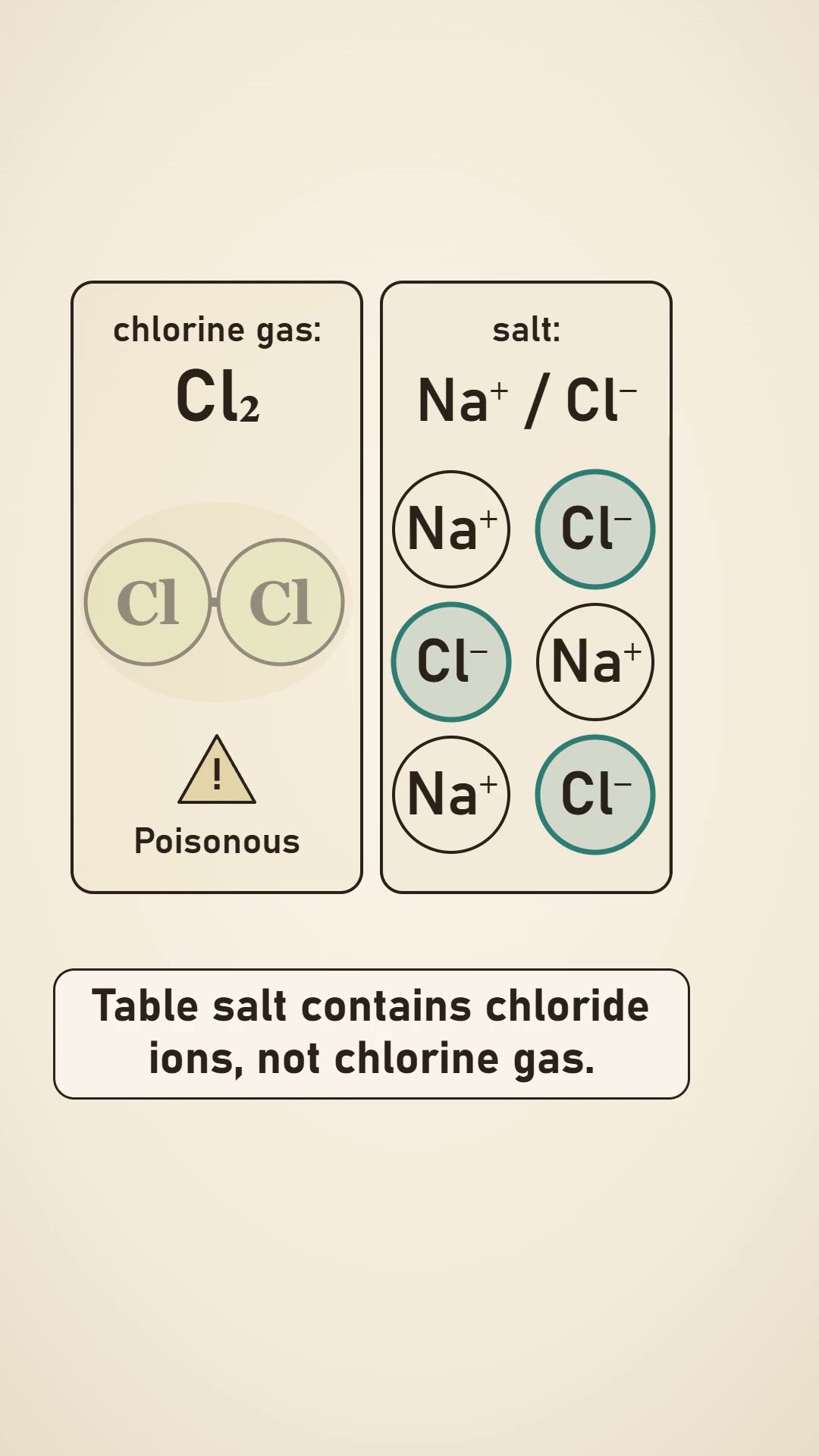
Chlorine and chloride are not interchangeable names for the same chemical form. Elemental chlorine is a poisonous gas; table salt contains negatively charged chloride ions in an ionic crystal. Chlorine-based pool disinfectants belong to another chemical context again. The pool and the salt crystal share an element, but that does not mean salt contains trapped chlorine gas, or that its chloride ions are the pool’s disinfectant.
It is a small change in language with a large change in meaning. The periodic table tells us which element is involved. It does not, by itself, tell us the properties of every substance containing that element.
Chlorine versus chloride: the distinction
The Royal Society of Chemistry identifies chlorine as element 17, with the symbol Cl. Its elemental gas is yellow-green and poisonous. In the formula Cl₂, the small two tells us that a molecule contains two chlorine atoms bonded together.
Chloride is different. A chloride ion is a chlorine atom with an extra electron and a negative charge. Its symbol is Cl⁻. The minus sign is not decoration: it identifies the charged ion rather than a neutral chlorine atom or a chlorine molecule.
Neither formula is a shorthand for the other. Cl₂ describes the bonded pair in elemental chlorine gas. Cl⁻ describes a chloride ion. Keeping those symbols separate prevents a familiar but misleading leap from a substance’s ingredients to its behaviour.
What is actually inside a salt crystal?
Table salt is sodium chloride, NaCl. OpenStax explains that it contains positive sodium ions and negative chloride ions arranged in a tightly bound, three-dimensional lattice. The ions are not little containers holding the original elements inside them.
A diagram of salt therefore needs a repeating arrangement of Na⁺ and Cl⁻ ions, not a collection of chlorine-gas molecules. Nor should it suggest that the solid consists of separate NaCl molecules. The formula describes the relative numbers of ions in the crystal; the lattice is the important structural picture.
The video animates this distinction with a bonded pair beside an alternating ion lattice. Those drawings are deliberately schematic. Their purpose is to separate a molecular gas from an ionic solid, not to show a way of turning one into the other.
Why the pool belongs in a separate panel
The Royal Society of Chemistry lists swimming-pool water treatment among chlorine’s disinfectant uses. That gives the pool a legitimate place in the comparison, but it does not erase the distinction between chemical forms.
The careful description is chlorine-based disinfectants. Their reactive chlorine chemistry kills germs. Salt’s chloride ions are not that disinfectant, and a diagram should not show an ordinary salt lattice sanitising the water. Equally, it should not present chlorine-gas molecules as a universal picture of the active disinfectant in every pool.
This comparison is about identity and properties, not preparation or handling. Chlorine gas’s poisonous character does not become a property of food salt merely because both contain the same element. OpenStax explicitly uses sodium chloride to illustrate how a compound’s properties can differ from those of its constituent elements.
Same element, different chemical forms: charge, bonding and structure make the difference.